
Why is it important to assess the carbon footprint of buildings?
Buildings are responsible for around 40% of global greenhouse gas emissions over their lifetime. They also use about half of the materials consumed in the European Union. Because of this large impact, both public rules and private efforts to reach carbon neutrality are creating a growing need for buildings with low carbon footprints.
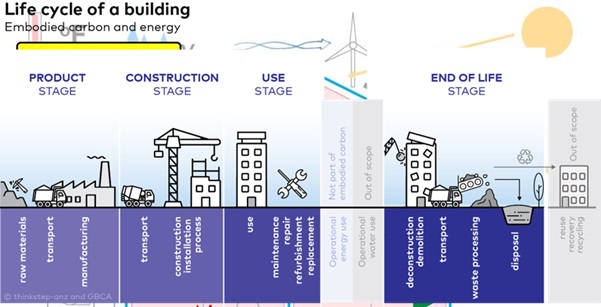
The total carbon footprint of a building includes emissions from extracting and making materials, transporting them, construction, maintenance, repairs, and replacing materials during the building’s life. It also includes the use of energy and water, as well as the demolition and final processing of building materials.
Right now, the largest part of a building’s carbon footprint comes from the energy used during its operation. But research shows that the emissions tied to the building materials also play a big role. As the energy sector becomes cleaner and buildings become more efficient, the share of emissions from materials becomes more important. For example, in countries like Norway and Sweden, most of the carbon impact from new buildings now comes from sources other than energy use.
Regulatory plans for life cycle carbon footprint
So far, building regulations in Finland and in many other countries have mostly focused on lowering carbon emissions through better energy use. These rules often required energy certificates and minimum efficiency levels. However, this approach has its limits. When Finland updated its building energy laws in 2018, most cost-effective improvements had already been made, and further gains were small. This means new ideas are needed to cut emissions further.
One clear step is to start regulating the entire life cycle of buildings. This includes emissions from material production, construction, maintenance, and the building’s end-of-life. Regulations based on emissions can also drive innovation and push companies to develop better materials and solutions. Finland’s Ministry of Environment plans to base future rules on the whole life cycle carbon footprint of buildings, starting from the mid-2020s. These rules will first be tested in public buildings. Other countries in Europe are also moving in the same direction. The Netherlands already has such rules in place, and countries like Sweden and France are planning to introduce similar ones.
What is the basis of the calculations?
The way to measure a building’s life cycle carbon footprint is set by European standards under the CEN / TC 350 group, which focuses on sustainability in construction. These standards include EN 15978 for assessing buildings and EN 15804 for environmental product declarations (EPDs) for building materials. These shared standards allow for consistent assessments across Europe and are also widely used around the world.
The Finnish Ministry of Environment is finalizing its national method based on these standards. It adds more details to guide users and ensure the rules are clear. A public review of this method ended in January 2019, and the final version is being developed using feedback from real projects.
This Finnish method includes emissions from material production, construction, replacements, building use, and the building’s end-of-life. The emissions are measured over the expected service life of the building, or a default of 50 years if no service life is defined. The emission values for energy use are based on set government goals to reduce emissions over time.
Besides the carbon footprint, the method also allows buildings to show positive effects, called the “carbon handprint.” This can include benefits like recycling materials, carbon stored in wood-based materials, reduced emissions from concrete carbonation, or selling extra renewable energy generated by the building.
Manufacturers can report their own emissions by publishing EPDs according to the EN 15804 standard. These declarations can cover individual products or groups of products. In Finland, EPDs are published by RTS. EPDs give a consistent and standard way to report the environmental impact of products, helping ensure the same information is trusted and used across markets.
How carbon footprint can be calculated and reduced in real life cases
A building’s carbon footprint is mostly shaped during the design stage. Once a building is built and in use, it is much harder to reduce its emissions. This means making the right choices during design is key to achieving a low carbon footprint. The best results come when carbon emissions are considered throughout the whole design process.
Decisions such as the building’s location can affect the energy sources available and how the foundation is built. Other early choices include the building’s shape, how space is used, the main materials used, and energy goals. Later in the design, important ways to cut emissions include improving energy efficiency, using renewable energy, selecting materials with a long lifespan, choosing recycled and renewable materials, and reducing how much material is used. Even the specific products chosen can make a big difference—some materials from less efficient suppliers can cause more than twice the emissions as similar materials from better suppliers.
To calculate the carbon footprint of a building, the following information is needed:
- Details on the types and amounts of materials used (from drawings or a building information model)
- Data on the emissions from making the materials and how long they last
- Calculations for how much energy the building will use and where that energy comes from
It is also possible to include project-specific data for things like transporting materials, construction activities, and end-of-life treatment. If this data is not available, default values can be used as outlined in the Finnish method.
The easiest and most accurate way to assess a building’s carbon footprint is to use assessment software. These tools include emission databases and follow the chosen calculation method. They help designers start assessments early, even when little information is available. In later stages, they speed up the process by linking to design tools like building information models. These tools also help ensure the assessment is done correctly. By using the right method, assessors can focus on collecting the needed data and analyzing results to support the project team.