
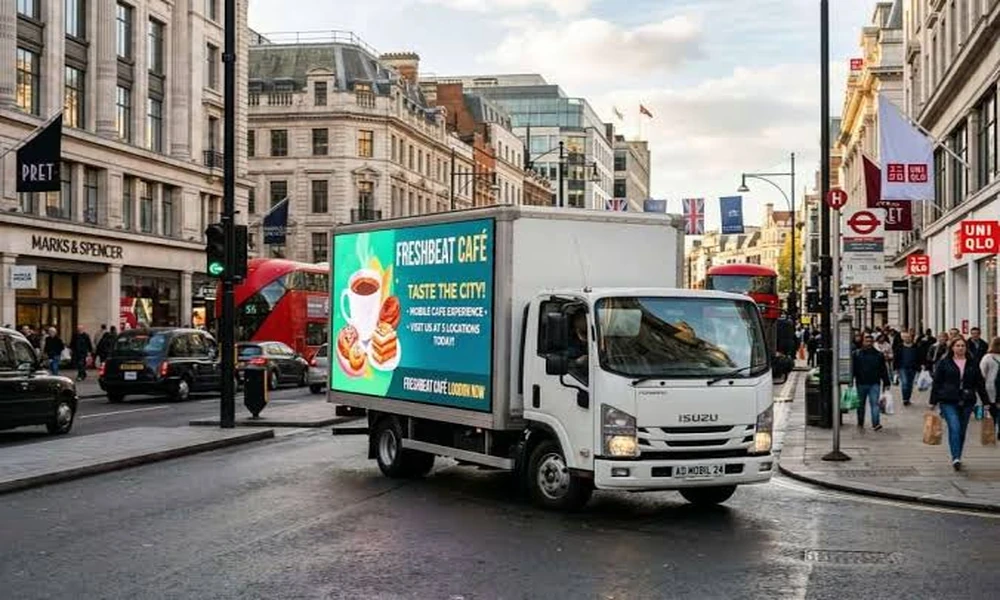
Rolling LED displays extend a retailer’s city route reach by treating an entire city as reachable territory instead of a single fixed address. The customers a storefront sees are the ones who happen to walk past it, and on most days, this represents a fraction of the actual customers a retailer wants to reach. LED rolling displays carry retailers’ messages well beyond the front door, moving along transit corridors, nearby neighbourhoods, and along commercial strips that a fixed sign could never reach. A mobile advertising truck makes this possible by tracing routes across an entire city rather than sitting parked at one intersection. This extends a retailer’s reach into areas where potential customers already spend their day.
City district expansion
City district expansion turns a single neighbourhood retailer into a citywide presence without opening a second location. A retailer with one store is still bound to that one neighbourhood unless the advertising itself moves. Rolling LED displays cross district boundaries the way a fixed billboard never could. They carry the same message from a downtown shopping strip into a residential suburb within the same afternoon. City district expansion matters most for retailers trying to draw customers from outside their immediate area, since a district’s own foot traffic often plateaus quickly, and the more customers a business already has locally, the smaller that untapped pool becomes over time.
Commuter route targeting
Commuter route targeting reaches shoppers during the exact stretch of their day when a stop on the way home is still an open decision. Most people don’t live where they shop, and a large share of retail decisions actually take place during the commute between the two. A retailer’s message can be captured during a window during which commuters are considering where to stop next by rolling LED displays that run along commuter routes morning and evening. By targeting commuter routes along the same corridor, ads reach the target audience daily rather than irregularly, creating a kind of repetition that a single fixed sign cannot duplicate.
Citywide repeat exposure
Citywide repeat exposure builds the kind of familiarity a single sign can never achieve on its own. A fixed sign gets seen once by someone passing it, and then not again unless that same person walks the same path tomorrow. A mobile advertising truck running a repeated city route builds frequency differently, appearing in front of different audiences at different points on the same day. It circles back through familiar streets where earlier exposure still lingers. Retailers running seasonal promotions benefit directly since a route can be adjusted week to week as a promotion shifts, without needing to book another physical location for each phase of a campaign. The route itself becomes the asset, not any single fixed point along it.
Rolling LED displays give retailers a way to treat an entire city as reachable ground rather than a series of disconnected neighbourhoods. City district expansion, commuter route targeting, and citywide repeat exposure together explain why this format keeps extending retail reach well past what any single storefront sign could manage alone.